
Roundtable Talk with Female Students and Faculty
Mathematical Science & Global Environmental Studies Course
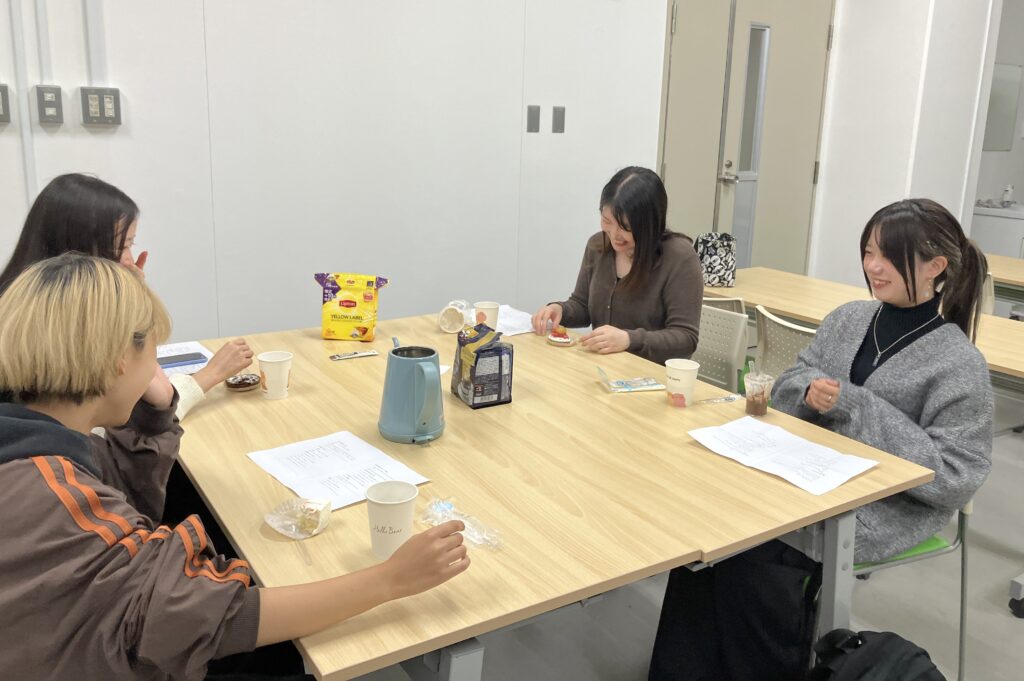
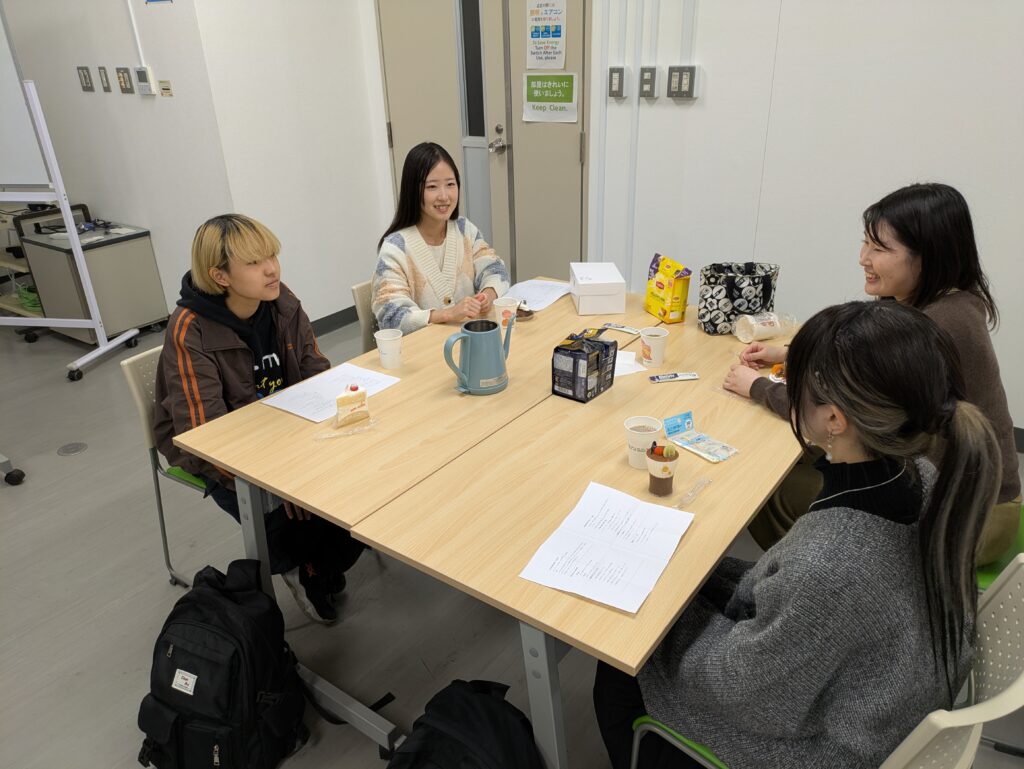
We held a friendly and lively roundtable discussion with female students studying in our department and a female faculty member. The distance between participants felt very small—everyone spoke openly about their experiences and thoughts in a relaxed and welcoming atmosphere.
Participants:
Oe (O) – 1st-year student, School of Environmental Science and Engineering, Department of Environmental Mathematical and Physical Sciences, Mathematical Science & Global Environmental Studies Course
Kikuchi (Ki) – 1st-year student, same course as above
Kondō (Ko) – 4th-year student, Faculty of Engineering Science, Mathematical Science Course
Prof. Hashizume (H) – Faculty member, Mathematical Science & Global Environmental Studies Course
About This Roundtable
H: Thank you all for joining this roundtable today. Starting this academic year, we introduced a special women’s admission quota for the Mathematical Science & Global Environmental Studies Course. We planned this roundtable so that high school students can better understand what university life is like. Our course has traditionally had more male students, so I’d like to hear your honest impressions after entering the Mathematical Science & Global Environmental Studies Course at Akita University.
University Life
H: Have you gotten used to university life?
O & Ki: It has been about six months since we enrolled, and we’ve gotten quite used to it. However, the second-semester classes are becoming more difficult, so we’re working hard.
Ko: In my year, we get along very well with the male students in the same course. Regardless of gender, we work on assignments together during breaks and chat a lot.
O & Ki: Because there are relatively few female students, it actually makes it easier for us to get together. Shortly after entering the university, we had already spoken with all the female students in the same department.
Why They Chose the School of Environmental Science and Engineering
Ki: I wanted to study mathematics and information science, and my parents also suggested that staying in Akita might be a good idea, so I chose this faculty.
O: I have always liked mathematics, and I also have relatives in Akita, so the area felt familiar and comfortable.
Why They Chose the Mathematical Science & Global Environmental Studies (Mathematical Science) Course
Ko: I’ve liked mathematics since high school, so it was natural for me to choose the Mathematical Science Course.
O & Ki: We also considered the Faculty of Information and Data Science, but the entrance examination for the School of Environmental Science and Engineering was held earlier. We planned to apply to Information and Data Science if we didn’t pass, but we were admitted here first.
Differences from High School and Impressions of University
O: My high school had a lot of freedom, so I was surprised that university is actually “properly like school.” We don’t have many specialized subjects yet, but I’m looking forward to what’s coming.
Ki: I was surprised at how many serious students there are. Many students go up to the professors after class to ask questions, and seeing that makes me want to work hard as well.
Ko: I actively attend classes that interest me and also balance club activities and part-time work. Compared to high school, my life feels much more fulfilling.
O: I’m also taking teacher-training courses. I’m not necessarily aiming to become a teacher, but I thought it would be good to have the qualification.
H: That’s very forward-thinking. Getting qualifications is tough, but once you have them, they become a strong advantage both in job hunting and later in your career. I especially recommend the “Mathematics, Data Science, and AI” Literacy and Applied Basic Level curriculum. If you complete it, you receive an official badge upon graduation, which looks great when applying for jobs.
Why They Chose Science in High School
Ko: I chose the science track without hesitation because I liked mathematics.
Ki: When I was asked what my favorite subjects were, it felt natural to choose the science class.
O: My high school didn’t have a strict division between humanities and science, so I could freely choose the subjects I liked. I think the real “science choice” happened at the time of the university entrance exam. In a teacher-training class, I learned data showing that there is no gender difference in strengths and weaknesses between science and humanities subjects, which matched my own experience.
Enjoyment of Student Life and Research Activities
Ki: I enjoy spending time chatting with friends between classes.
H: I understand completely. When I was a student, I used to go to a café every week.
Ko: I love traveling, and it makes me really happy when the foreign language I studied is understood locally. In my seminar, I also put a lot of effort into research, and it’s very rewarding when I can answer tough questions.
H: You’ll be busy with your thesis and also planning your graduation trip, right?
Ko: Yes, that’s true. laughs I’m thinking about Europe.
Message to High School Students
O & Ki & Ko: Cherish what you love. Don’t just go along with what others do—following your own interests is the most important thing.
Roundtable Talk with Female Students and Faculty
Functional Device Physics Course
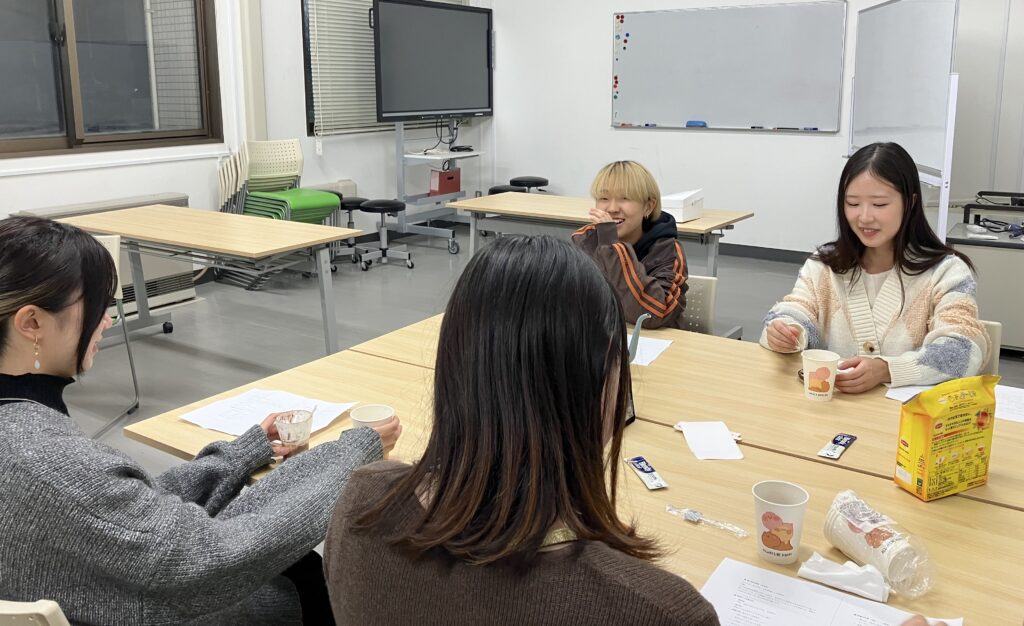
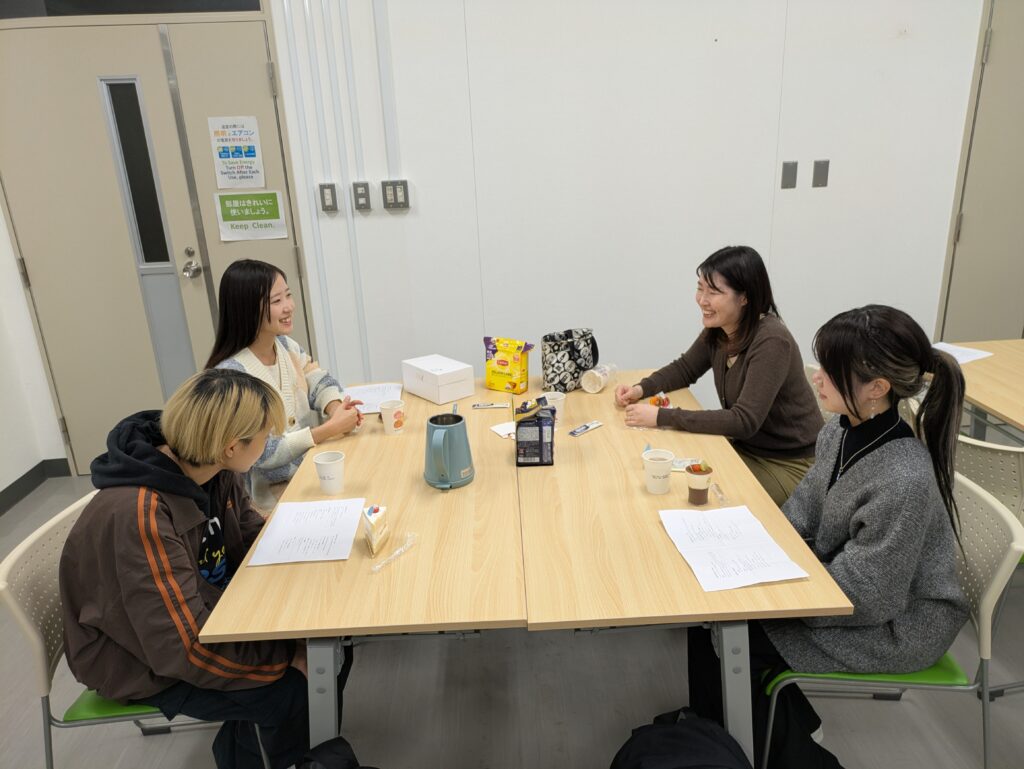
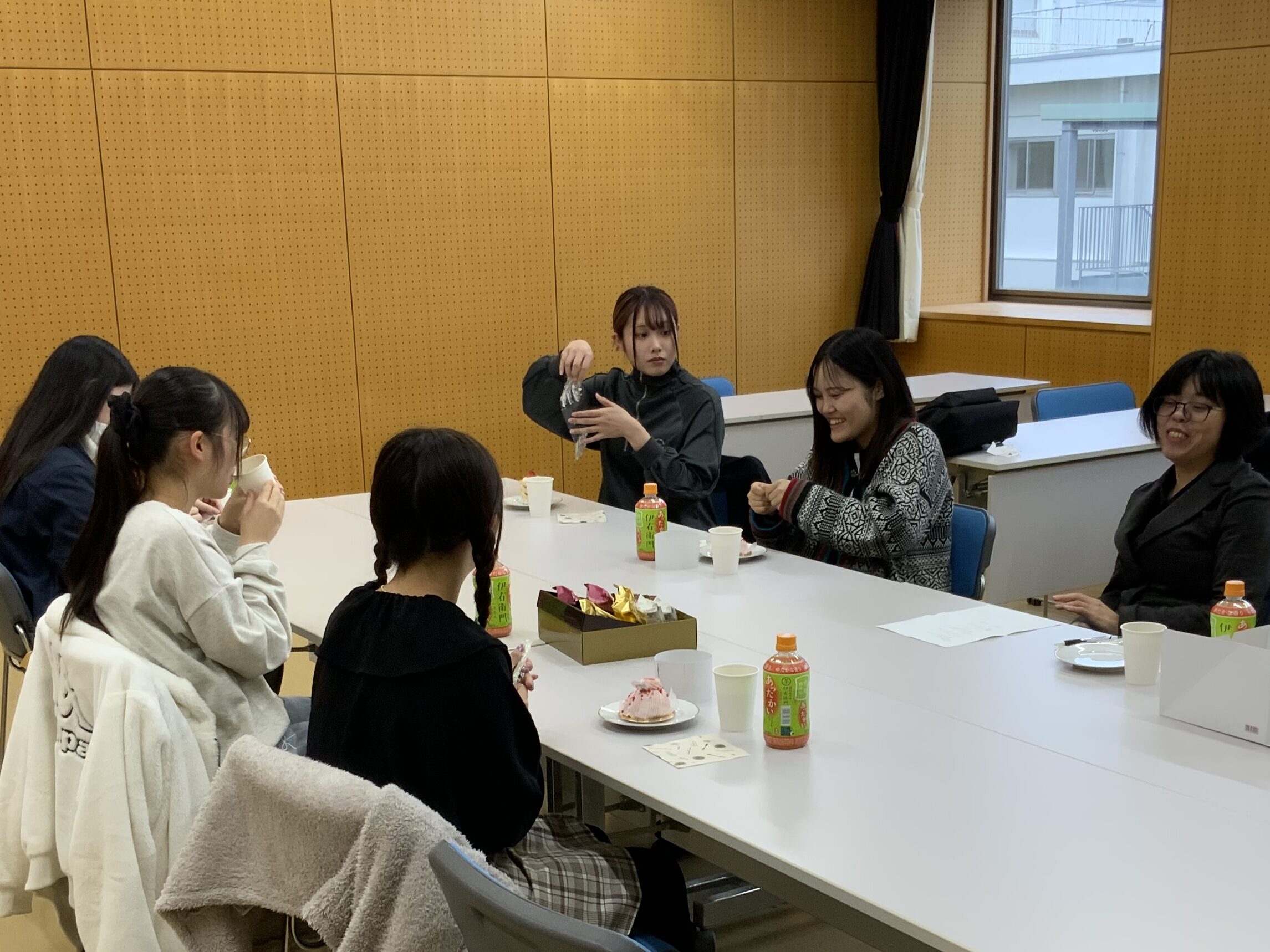
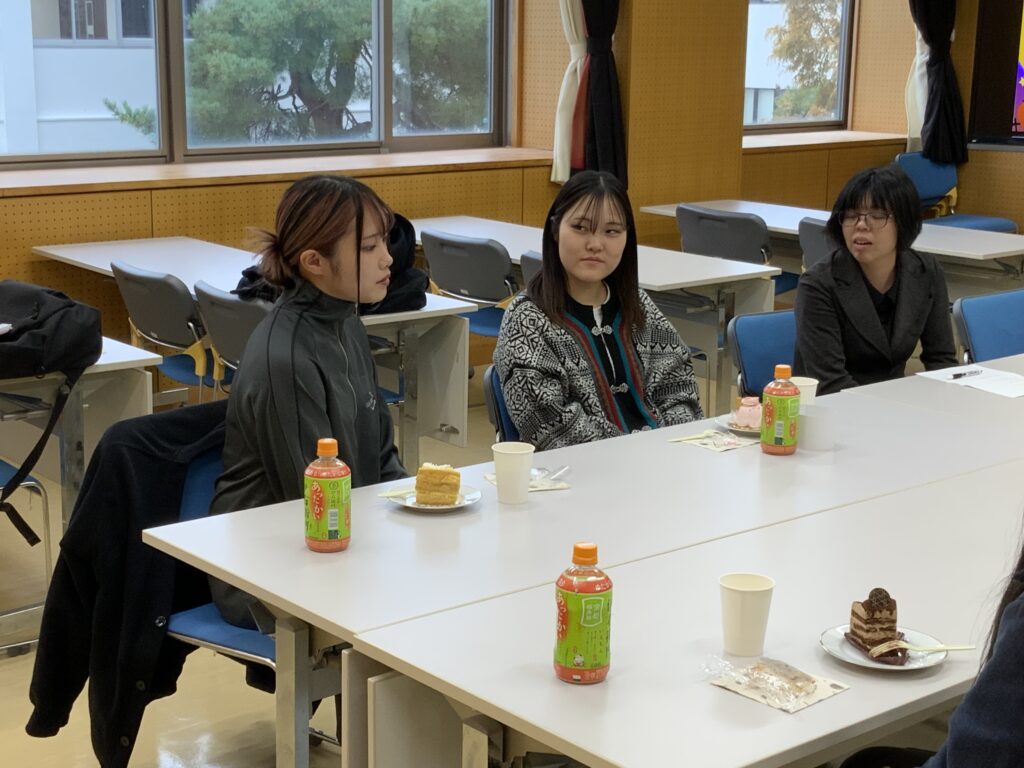
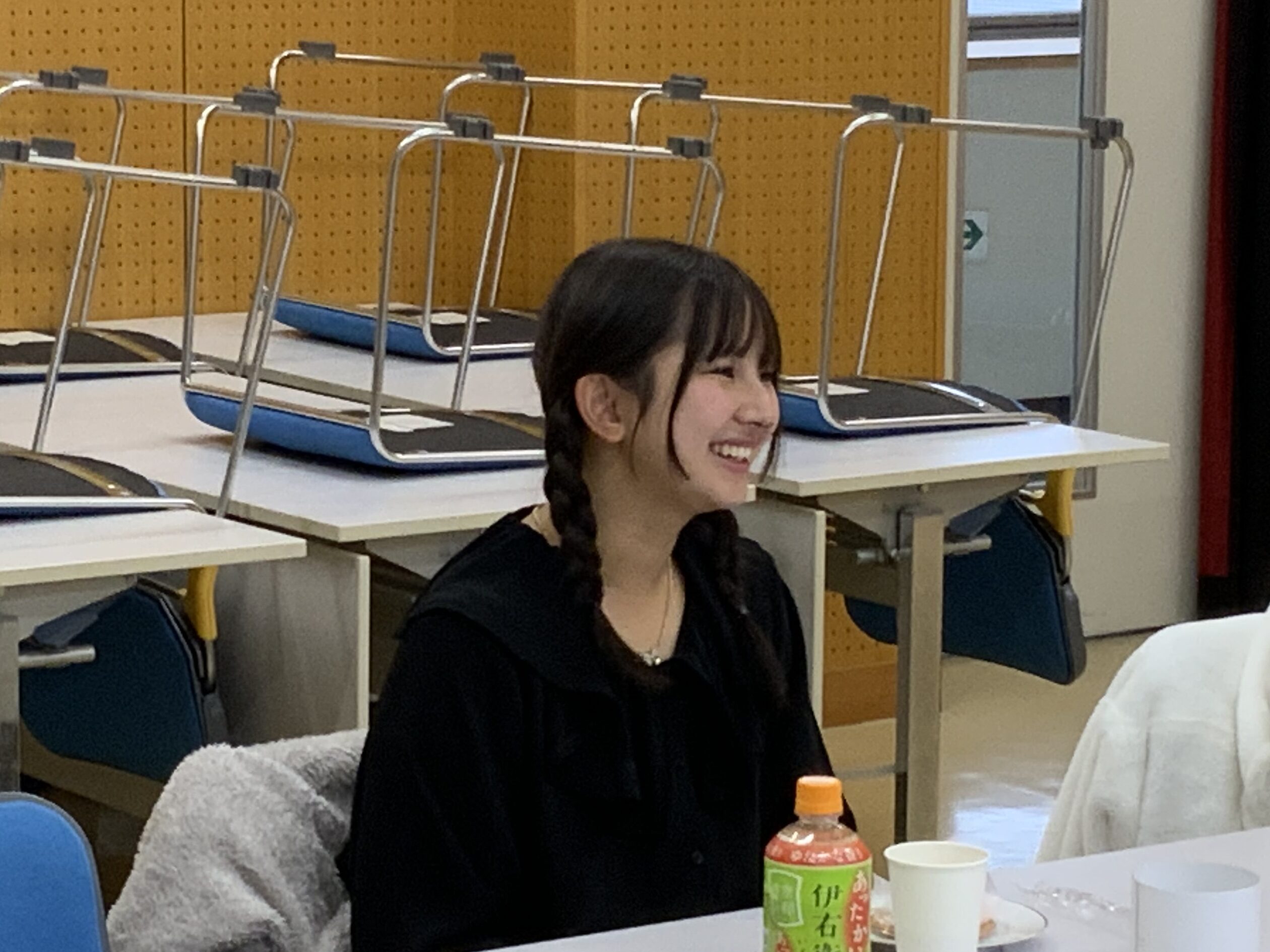
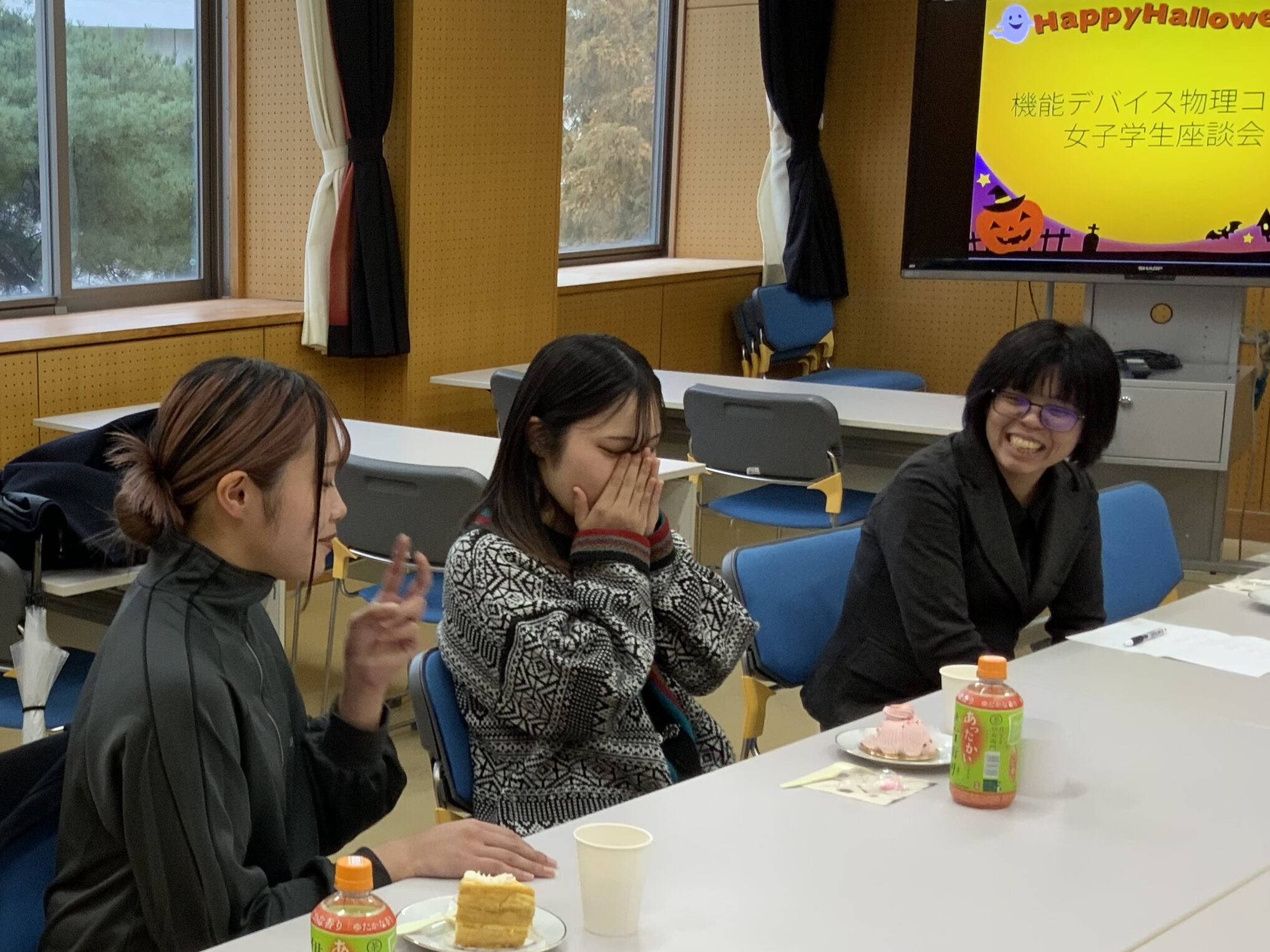
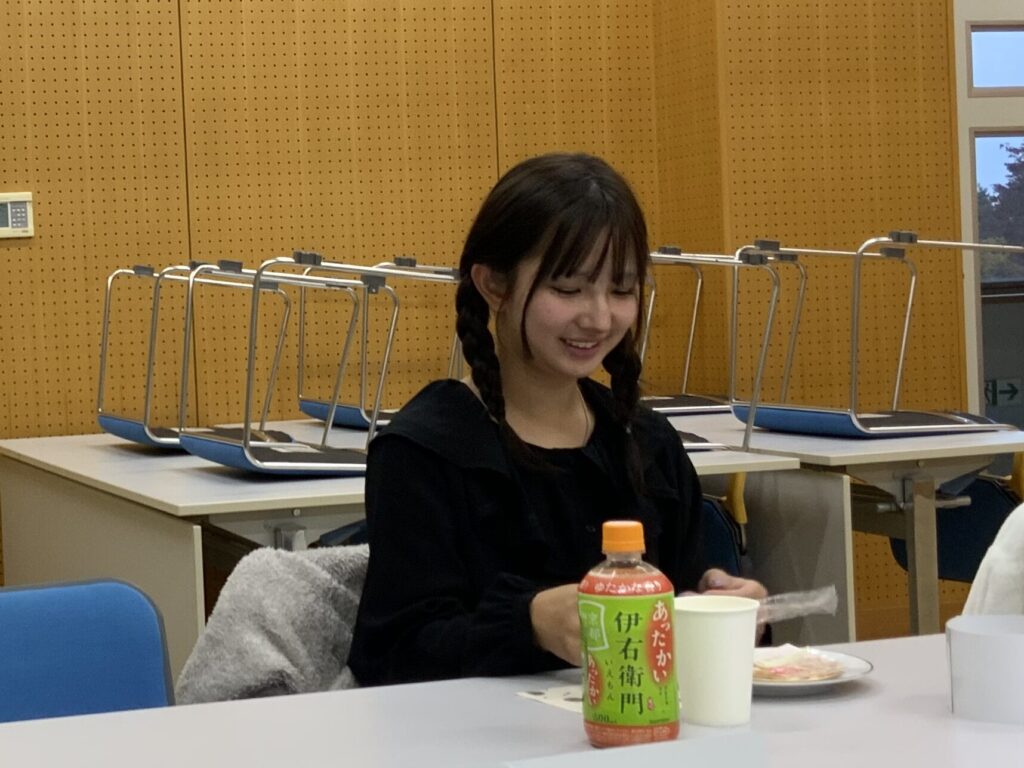
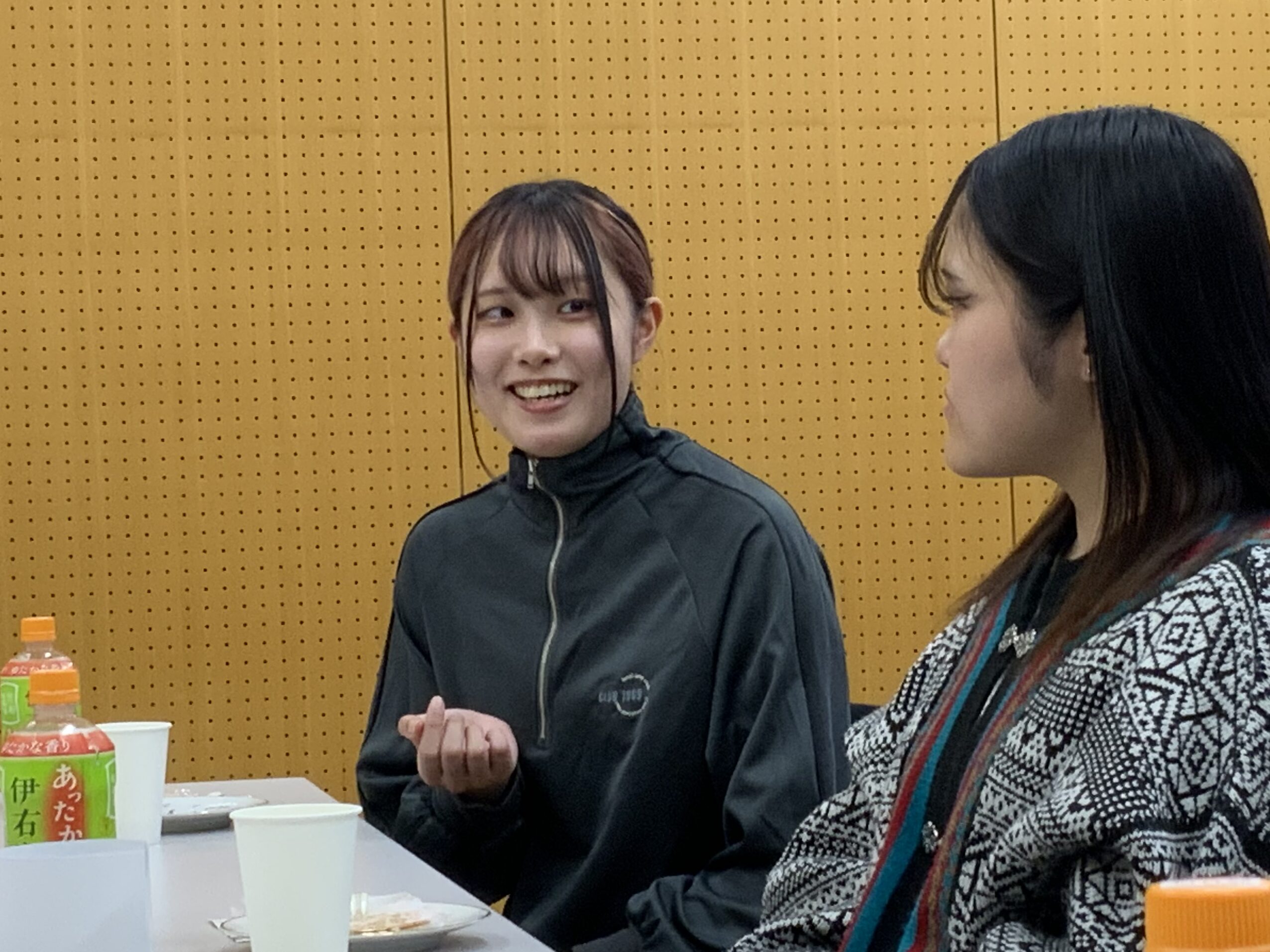
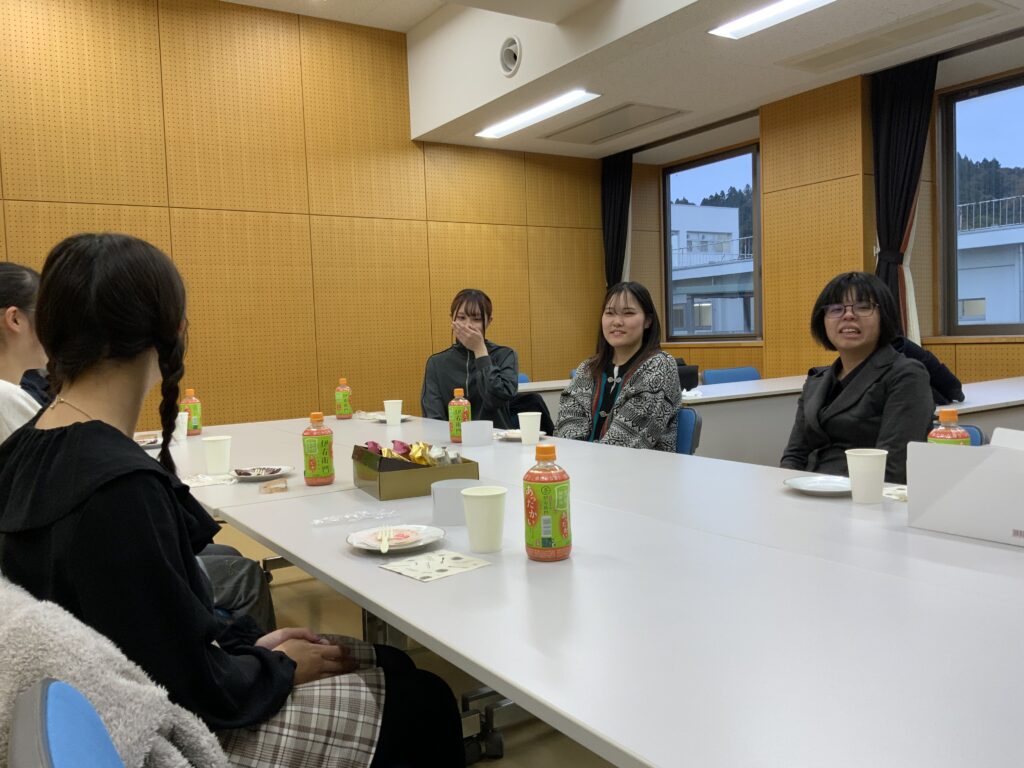
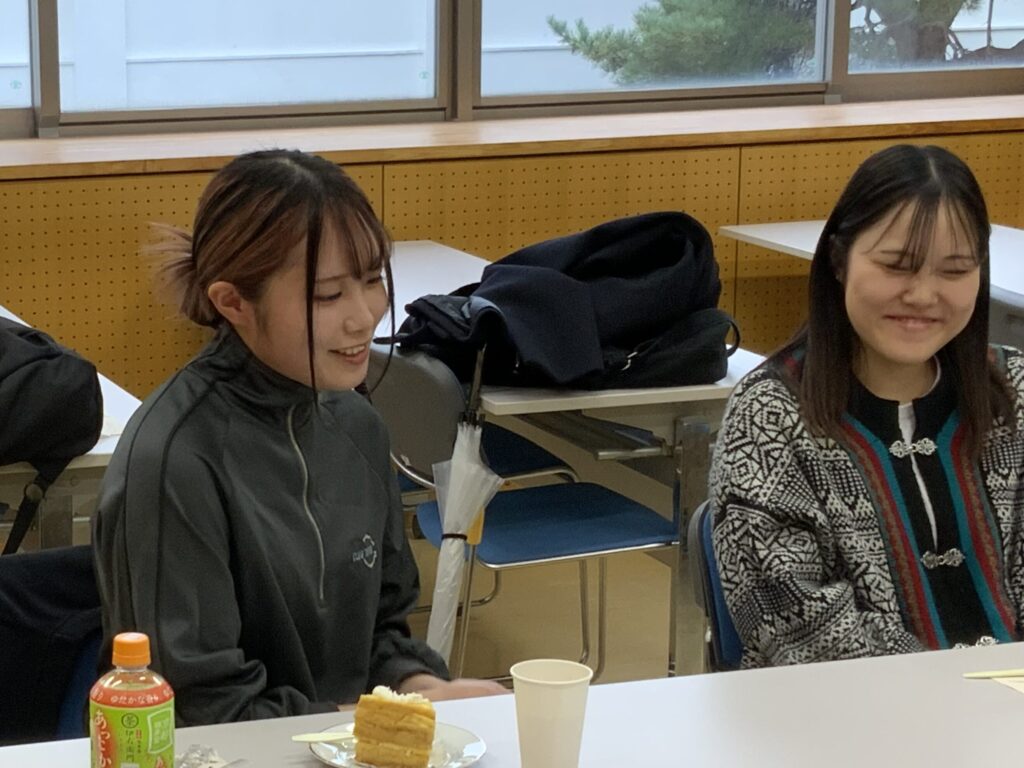
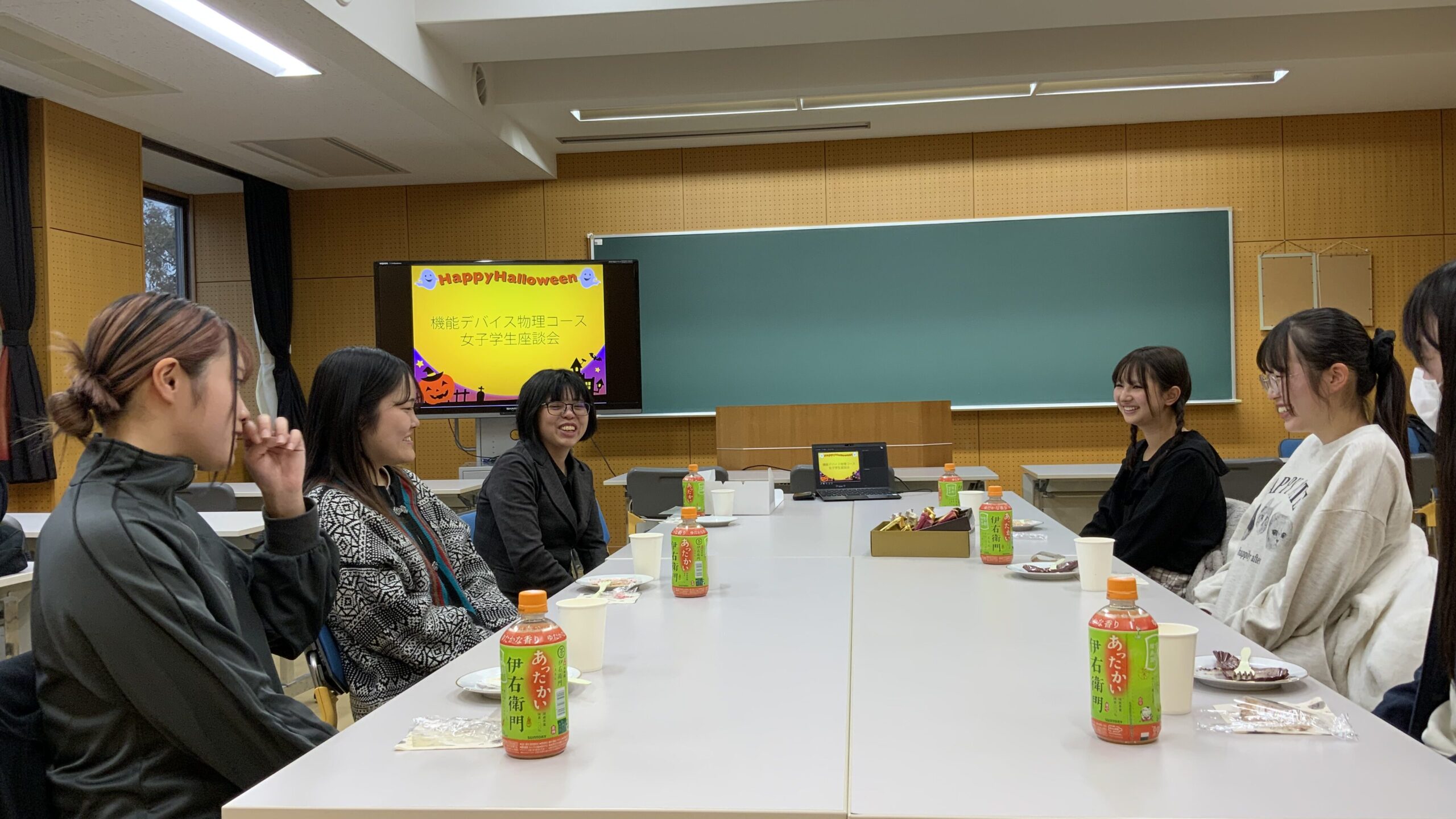
We also held a roundtable with female students studying in the Functional Device Physics Course, senior female students from related courses, and a female faculty member. The meeting happened to take place around Halloween, so participants enjoyed sweets during the discussion, sharing their experiences and everyday thoughts in a warm and friendly atmosphere.
Participants:
M (M) – 1st-year student, Functional Device Physics Course, Department of Environmental Mathematical and Physical Sciences
Izumi (Iz) – 4th-year student, Electrical and Electronic Engineering Course
Takada (T) – 4th-year student, Electrical and Electronic Engineering Course
I (I) – 4th-year student, Electrical and Electronic Engineering Course
Mutō (Mu) – 4th-year student, Materials Science and Engineering Course
Prof. Hosogi (H) – Faculty member, Functional Device Physics Course
Self-Introductions and the Decision to Pursue Science
H: Let’s start with introductions. I’m Ai Hosogi from the Functional Device Physics Course. I joined the university in April last year and conduct research on sensors using optical fibers.
Mu: I’m Mutō, a 4th-year student in the Materials Science and Engineering Course. My research focuses on materials that convert ultraviolet light into visible light and on solar cells.
Iz: I’m Izumi, a 4th-year student in the Electrical and Electronic Engineering Course. In the Fukuda–Nishihira Laboratory, I work on detecting defects in materials using ultrasound.
I: I’m a 4th-year student in the Electrical and Electronic Engineering Course. In the Yodokawa Laboratory, I evaluate damage in cellulose nanofiber materials using near-infrared spectroscopy.
T: I’m Takada, also a 4th-year student in Electrical and Electronic Engineering. In the Kikuchi Laboratory, I research magnetic particles used to store data on hard disks.
M: I’m M, a 1st-year student in the Functional Device Physics Course. At the moment, my daily life is mainly focused on lectures.
H: Thank you. Could you tell us what led you to choose the science track?
M: I liked arithmetic and mathematics from elementary school, and my interest grew when I studied physics in high school, so I decided to pursue science.
H: When did you have to choose between science and humanities in high school?
M: I chose the physics course in my second year. My father also works in a science-related field, so I think that naturally influenced my decision. Among about 120 students, there were around 10 girls—so we were a minority.
Mu: My family is also science-oriented. My interest in science really grew when I enjoyed doing independent research in junior high school. I initially wanted to join the Applied Chemistry Course, but my interests shifted, and I ultimately chose Materials Science and Engineering.
Iz: I played in the brass band, and I started wondering, “Wouldn’t it be interesting to perform using electronic instruments?” That curiosity about how such instruments work led me to choose science. I selected physics in my second year of high school and committed to the science track.
I: I liked science and wasn’t very good at Japanese language, so it felt natural to choose science. I entered a science and technology program in high school and then continued on to a science-focused university.
T: I was good at mathematics and not so good at social studies, so choosing the science track was an easy decision.
H: You all have very “science-like” reasons for your choices!
Gaps and Discoveries After Enrolling
H: After entering university, did you notice any gaps or new discoveries?
M: In high school, we studied physics without really using calculus, but at university there are many more mathematical approaches, which has been eye-opening.
Iz: I realized that language skills are important even in science. Logical writing and reading comprehension are essential for writing proofs and discussion sections. I’m glad I took modern Japanese seriously in high school.
I: Every time I write a lab report, I feel the importance of Japanese language skills. We have reports almost every week, so my writing ability has improved a lot.
Mu: Materials Science also requires many reports, and they are all handwritten, which is more demanding than I expected.
H: So even in science, writing and expression skills are crucial. How about the ratio of female students?
M: There are more female students than I expected, which was reassuring. However, there are still fewer women who choose the physics-related courses, so I do feel a bit anxious.
Iz: At the entrance exam, I was the only girl in the room, which surprised me, but once I enrolled, I found more female students than I thought.
Mu: There were many women in the first year, but as students move into chemistry-related fields, the numbers in physics and electrical fields tend to decrease.
T, I: We don’t particularly feel uncomfortable about the small number of women.
Campus Life and Relationships
H: How is your social life and relationships with friends?
M: Because there are fewer women, we grow close more quickly. The small number makes it easy to open up and form strong bonds.
Mu: Our year started during the COVID-19 pandemic with many online classes, but perhaps because of that, the small group became very close.
Iz: I talk with male students a lot as well. Differences in perspectives can be stimulating and lead to good learning experiences.
T: You naturally meet people at the cafeteria and other shared spaces. Even students from different courses end up connected.
I: I often spend time alone, which I actually enjoy—it’s comfortable for me.
H: It sounds like each of you is building good relationships in your own way, regardless of gender.
The Fun and Challenges of Classes and Research
H: What do you find fun or difficult in classes and research?
M: Experiments are really fun. Writing the reports is tough, but the experiments themselves are exciting.
Mu: I appreciate how professors connect lectures to real-world examples from their own specialties. Compared to high school, I can now clearly see how what we learn links to future applications.
Iz: I enjoy how lecture content builds over time. It’s like the first session plants a seed, and by the final session, everything connects—like a story where foreshadowing is revealed at the end.
T: Preparing for seminar presentations is hard work. I spend a lot of time creating slides.
I: Balancing experiments and materials preparation is challenging. Since my room only has a low kotatsu table, I often come to campus to concentrate on my work.
Strengths of Being a Woman in Science
H: As women in science and engineering, do you feel any advantages?
M: Because there are fewer women, professors and seniors tend to remember us more easily, which sometimes makes it easier to start conversations.
Iz: During job hunting, I felt that being “a woman in electrical and electronic engineering” made me stand out, and I sensed strong demand. I think being a woman in science can be a real strength.
T: I also felt it was advantageous in job hunting.
Mu: At first, I was worried about being in a male-dominated environment, but after talking with classmates, I quickly became comfortable. Living alone in a new environment also helped strengthen my communication skills.
H: I agree—students at Akita University tend to be calm and kind, regardless of gender.
Future Goals and Career Paths
H: What are your future plans and career goals?
M: I haven’t decided on anything specific yet, but I hope to find work in research or development—something I can truly enjoy.
Iz: At first, I wanted a development job, but as I studied, I also became interested in more hands-on, field-oriented work. Being able to think flexibly about my future has been a big gain.
T: I had planned to go to graduate school, but I realized that research might not suit me, so I changed course and decided to start working instead. I now feel there are many jobs where I can use my science background outside of research.
I: I will be working for an auto parts manufacturer. I’ve been interested in automobiles since high school, so I’m glad I found a job close to my interests.
Mu: I aim to work in R&D related to energy. I want to be involved in research and development in a company.
Messages to High School Students
H: Finally, do you have any messages for high school students who are thinking about their future paths?
Mu: If you’re undecided between science and humanities, I recommend choosing science. You might feel uneasy because there are fewer girls, but things usually turn out fine.
M: It’s difficult to move from humanities to science later, but going from science to humanities is relatively smooth. If you’re unsure, choosing science may lead to fewer regrets.
Iz: Try not to worry too much about the gender ratio—prioritize your interests. Everyone feels nervous at first, so don’t let that stop you from taking on new challenges.
I: Science offers a wide range of future options. You can go into many different fields, so I encourage you to give it a try.
T: Engineering and science are incredibly attractive areas of study. Have confidence and take the leap!
A Day in the Life of a Student
An article featuring a day in the life of a 2nd-year Mathematical Science Course student, Mio Ōnuki, has been published on the “A Day in the Life of Students” page of the national 55 Engineering Faculties website.
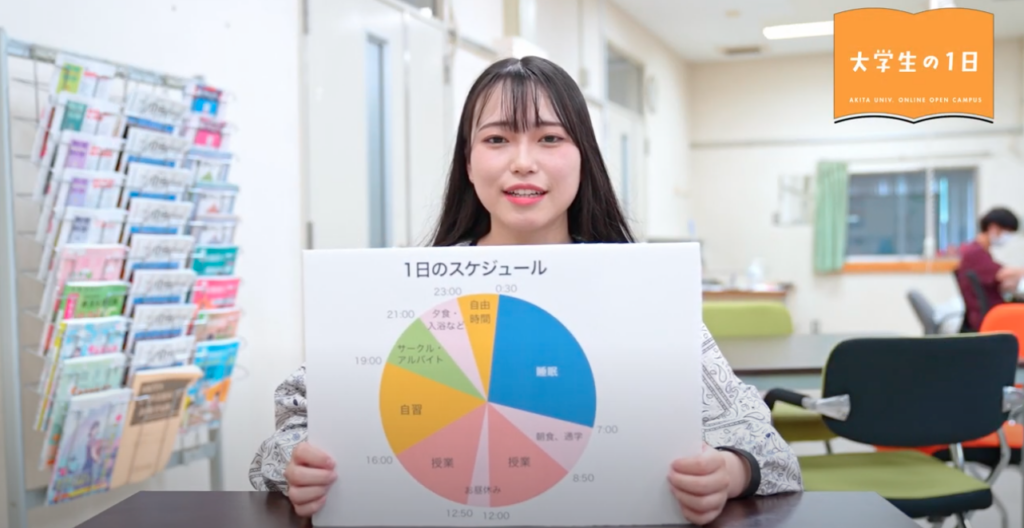
A Day in the Life of a Second-Year Student in the Mathematical Sciences Course
Harassment Prevention and Response Guidelines
Akita University is committed to providing a safe educational environment where all students, faculty, and staff can study and work with peace of mind. As part of this effort, the university has established guidelines for the prevention of harassment and has put in place a system for appropriate response.
For details, please see the following link:
Harassment Prevention Guidelines